#TWIGE - 07 - Callaway Full Toe SP puts the open-face shot first
Callaway’s Full Toe SP wedge was announced on 21 August. Its unusual shape makes sense only when the shots in your short game make use of it.
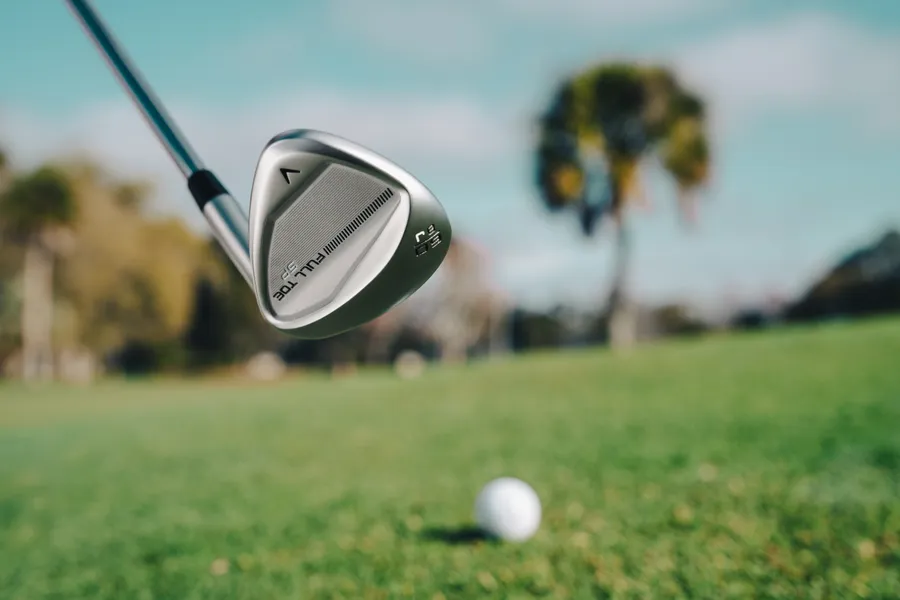
Photo: © Callaway Golf Company. Used by permission. All rights reserved..
Callaway announced the Full Toe SP on 21 August with a shape that asks a useful question: what do you actually use your most lofted wedge to do?
This is a tall-toe wedge with grooves across the face, noticeable offset and a sole designed to be opened. It is aimed at the awkward part of the short game: bunker shots, thick rough and shots where the face is deliberately laid open. Callaway’s US announcement put it on pre-order immediately, with retail availability due on 4 September. That makes this an announcement-week story; the later shop date is a separate development.
The central idea is easier to understand when we forget the headline spin language for a moment. Opening a wedge changes how the club meets the ball. Contact can move higher and towards the toe, beyond the grooved area on a conventional face. Full-face grooves put score lines where those strikes may happen. They do little extra work when a golfer presents the face square and repeatedly strikes its centre.
That distinction matters. Callaway describes the Full Toe SP as a versatile, high-spin option. The extra grooved area is real and visible; the resulting performance remains a manufacturer claim until it is tested under stated conditions.
Three design choices working together
The full-face grooves are only one part of the head. Callaway has also removed mass from low in the head through its Spin Pocket construction and moved the centre of gravity higher. The company’s intended result is lower launch with more spin when the face stays square. Offset is then meant to help add launch when the face is opened.
It is an interesting attempt to give one head two different behaviours. It is not evidence that every golfer will produce either result. Delivery, strike, lie, ball and turf still matter.
The sole is the other part of the equation. The J grind uses heel relief and camber — curvature from front to back and from heel to toe — so less of the sole meets the ground at once. In principle, that should make the face easier to open without lifting the leading edge excessively. The standard range runs from 54° to 62°, with bounce reducing as loft rises. A wider, higher-bounce JW grind is offered only at 62° for a more straightforward bunker option.
That is a specialist range rather than a complete wedge set. There is no gap-wedge loft because the design problem is most relevant around the green. A golfer who uses a 54° mainly for square-faced full shots may value a different sole and shape from someone who opens a 58° from rough several times a round.
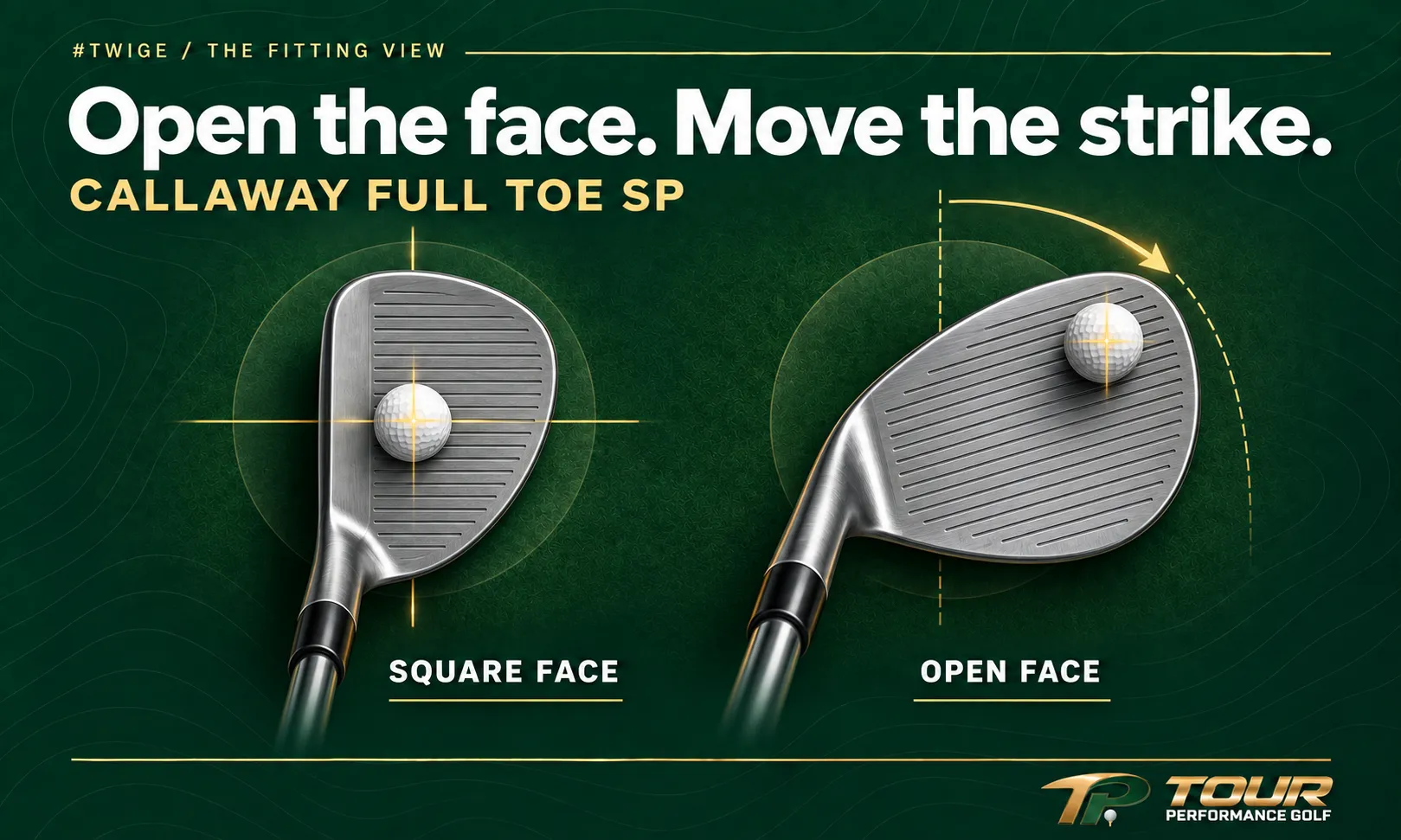
Square and open faces, illustrated with generic wedge heads.
What the first independent look can and cannot tell us
Tony Covey’s launch analysis for MyGolfSpy provides a useful counterweight to the release. He explains that grooves near the toe only become relevant when impact moves there, and that the visual shape and offset will divide opinion. He also tried the wedge at Callaway’s performance centre.
His caveat is as useful as the favourable impression: there was no launch monitor, and he found the local grass unusually easy for stopping the ball. He reported plenty of check but did not attribute it to the Spin Pocket. That is an honest early look, not an independent performance verdict.
The shape became the conversation
A same-day r/GolfGear thread asked whether the club was effectively a return to Callaway’s older PM Grind. Replies during the week concentrated on the curved leading edge, the familiar high-toe lineage and, repeatedly, the appearance. It demonstrates a specific conversation, not a representative verdict from golfers.
The reaction is still relevant because a wedge’s shape affects confidence. If the offset or tall toe distracts you at address, the engineering case may never get a fair trial. If the larger face makes an open-face shot look easier, that may be useful — provided the sole also suits the way you deliver the club and the ground you play from.
A better trial than a spin contest
For a UK golfer, availability needs checking rather than assuming. The dated announcement gives US pricing of $199.99 and a 4 September retail date; it does not establish a UK price, stock position or fitting options.
When the head is available to try, take the shots that expose the design. First use impact tape or another suitable marker to check where the ball meets the face; then remove it and clean the face before judging launch and stopping. Hit a square-faced pitch from a clean lie, an open-face shot from short grass, one from rough and several bunker shots. Compare the patterns and strike consistency with your present wedge. Include the ordinary miss, not just the best result.
If most contact stays central and most shots are played square, full-face grooves may solve a problem you do not have. If contact moves high and towards the toe when the face opens, this head has been built around that pattern. The useful part of the Full Toe SP is not that it promises more creativity. It gives a fitting a very specific claim to test.
TWIGE — This Week in Golf Equipment. #TWIGE