#TWIGE - 14 - Arccos Air removes club sensors, not the post-round edit
A season-long independent review finds that sensorless shot tracking can build a useful record, provided the golfer accepts that club selection still needs checking.
This Week in Golf Equipment · Edition 14 · Reporting through 8 October 2026
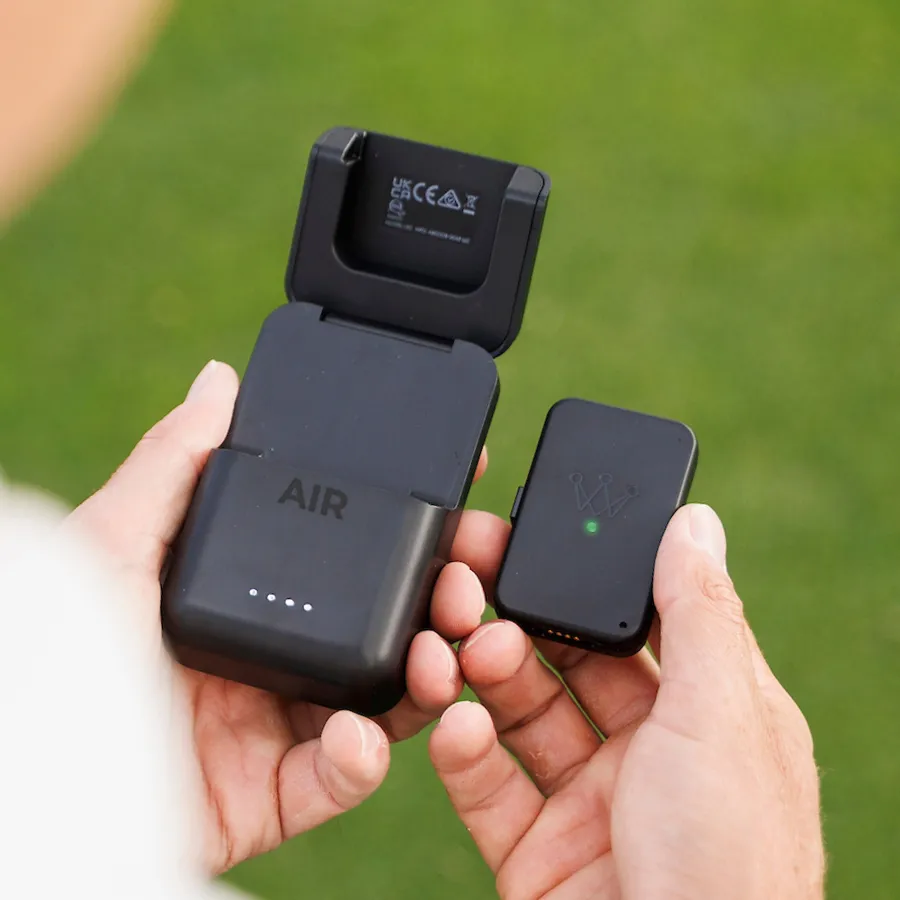
Arccos Air wearable and wireless charging case. Product photograph: Arccos.
Arccos Air promises something attractive to any golfer who has resisted shot tracking: attach one device to your belt, leave the phone and club sensors out of the swing, then receive a mapped record of the round.
The hardware is not the new part. Air uses the same device as Arccos Link Pro. A software update added sensorless tracking, with the system estimating which club produced each detected shot. The more useful news this week is that Golf Monthly has now published a season-long independent review rather than another first-round impression.
Its verdict is encouraging, but it also exposes the real trade-off. Air can remove the sensors. It cannot remove the need to check the record.
Detection is not identification
Arccos explains that Air combines its belt-worn hardware with a feature called Smart Club Selection. When no club sensors are present, the system uses a golfer’s expected distances, shot history and position on the course to estimate the club. The golfer can also tag the club manually or correct it after the shot.
That distinction matters. Hearing the strike and locating the next shot is one problem. Knowing whether the golfer used a soft seven-iron, a full eight-iron or a recovery club is another.
Golf Monthly’s Sam De’Ath, a five-handicap golfer using a shot tracker for the first time, wore Air through the summer, mainly at Royal County Down. He estimated that it identified the correct club on 60–70% of shots. He also found that post-round checking became quicker with familiarity, but still advised allowing roughly five to ten minutes to review and edit the round.
Those figures describe one golfer’s experience, not a controlled accuracy rate. They are still more informative than a promise that tracking is simply automatic.
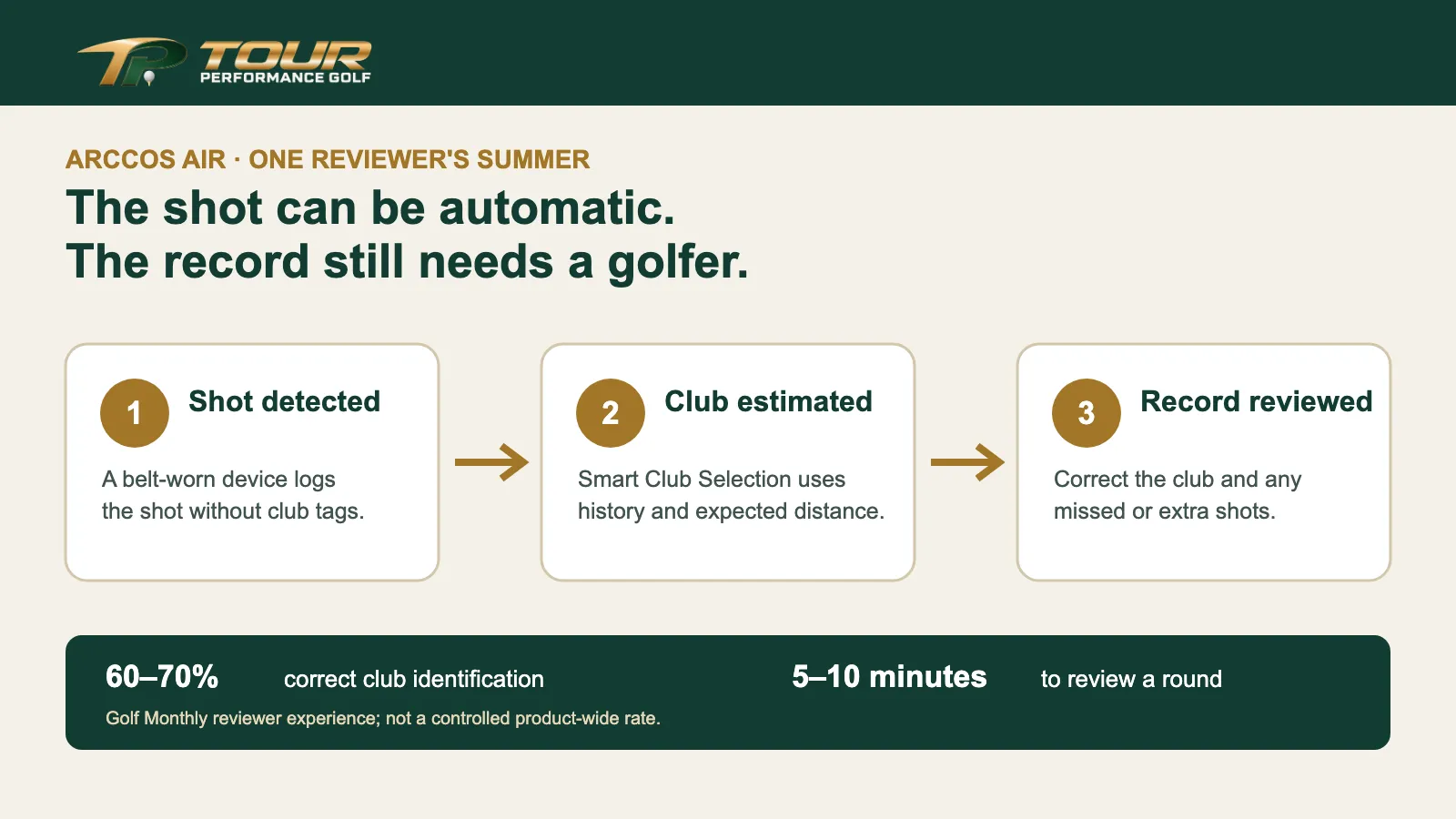
Automation can detect the shot; a golfer still has to verify the club and the resulting record. Figures are from one Golf Monthly reviewer’s season, not a product-wide test.
The value comes after the correction
Editing is not merely administration. Club-level data is what turns a map of shots into decisions about distance, dispersion and course strategy. A wrongly labelled club contaminates the very trends the system is meant to reveal.
De’Ath nevertheless found the process useful. His long-term Arccos Air review reports reliable shot detection, accurate distances and a clear app, with only occasional GPS delays and the expected corrections. After learning the routine, he says the review could take under five minutes, although his buying advice sensibly budgets more.
That sounds like the right way to judge the product. Air is not a frictionless witness. It is a rapid first draft of the round which the golfer finishes.
The alternative remains club sensors. They identify the club directly and, in De’Ath’s comparison, were more accurate and cheaper. Their disadvantages are physical: a sensor on every grip, the possibility of a loose sensor and another object visible at address. Air shifts that friction from the club to the score review.
Price the habit, not just the device
Arccos currently lists Air at £309.99 in the UK, including the first year of membership. Continued use requires an active Arccos membership, so this is an ongoing service rather than a one-off rangefinder purchase. The current UK product page is the right place to confirm price and terms before buying.
A golfer who already records every round, reviews mistakes and acts on patterns may find that worthwhile. Someone who dislikes post-round corrections is unlikely to discover a new personality because the sensors have disappeared.
Public discussion shows the same tension. In one small Reddit thread after the Air update, a user reported a wrong club almost once per hole. That is an anecdote, not representative testing, but it identifies the question a trial should answer: how much correction does your game require on your course?
The practical test is simple. Use Air for several complete rounds, including one with unusual tee clubs, lay-ups and recovery shots. Correct every round while the decisions are fresh. Then inspect whether the resulting club distances and patterns tell you something you can use. If the edit feels burdensome before the data becomes valuable, the convenience promise has failed for you.
Arccos Air makes serious tracking less intrusive during play. The independent evidence suggests that is real progress. It also shows that accurate club data still depends on a golfer doing a short piece of honest work afterwards.
TWIGE — This Week in Golf Equipment. #TWIGE